Strength or Coordination: They Are Not the Same, Even If the Exercise Looks Identical

In Pilates, there are nuances that can completely change the outcome of your class. And one of the most important is understanding whether you are training strength or coordination.
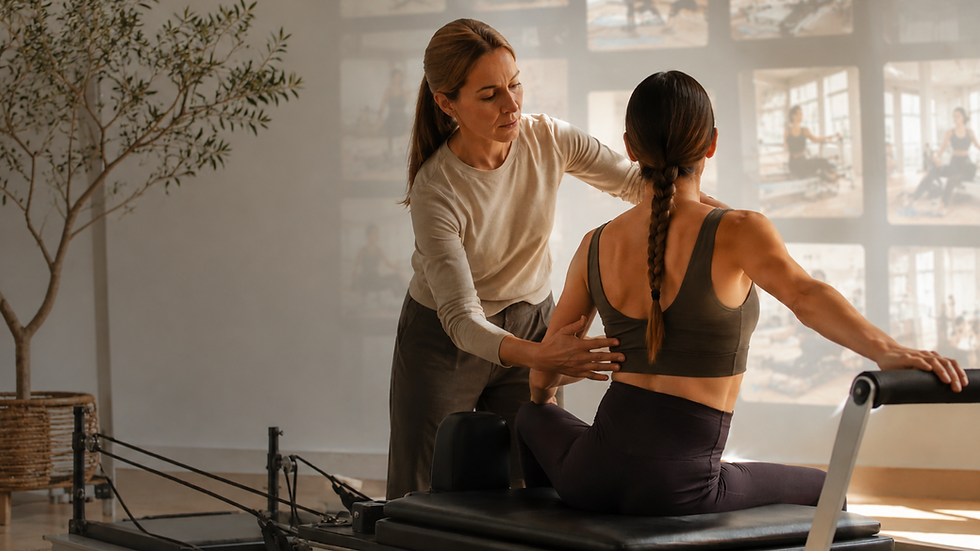
At first glance, it may look exactly the same. Your student is on the Reformer, performing the same gesture, following the same sequence. But when we refine our perspective as Pilates instructors, we understand that the objective can be radically different.
When the Focus Is Coordination
Imagine a hip extension exercise on the Reformer using a very light spring. The load is minimal, but the demand is not. The student needs to maintain lumbopelvic alignment, correctly dissociate the hip, and sustain control without letting the body “escape.”
What is truly being challenged here is not how much force they can produce, but how they organize movement. The demand is neuromuscular, proprioceptive, and refined. Each repetition feels clearer as the system learns. There is no dominant fatigue; there is precision.
This type of work is ideal during initial phases, in postural reeducation processes, or when working with someone experiencing pain. We are not trying to exhaust them. We are helping them understand.
When the Focus Is Strength
Now, if you perform that same exercise with a heavier spring, the scenario changes. Resistance requires overcoming load. Fatigue appears. Maintaining technique is no longer only a matter of control, but also of muscular endurance.
Here we are developing strength in the hip extensors, the core, and the ability to maintain quality under demand. Each repetition becomes more difficult, not clearer.
The movement is the same. The intention is not.
What Changes the Way You Teach
As instructors, we often modify loads without stopping to think about what we are truly training. We adjust the spring, but we do not redefine the objective.
The same exercise can be therapeutic or performance-oriented. It can educate control or challenge strength, depending on how you approach it. Understanding that difference is not a minor technical detail. It is what allows you to personalize with intention, offer safe progressions, and provide more precise responses for each student.
Not everyone needs more intensity. Some people need more coordination. And knowing how to distinguish between the two is part of professional maturity.
Because in Pilates, what makes the difference is not always what you can see… but what you understand is happening as an instructor.


Comments