The Invisible Power of Language in Your Classes

Have you ever thought about the real weight a single phrase can have inside your class?
I’m not talking about a complex technical correction. I’m talking about something much simpler. A sentence. An almost automatic comment. A way of saying things, or even an intentional joke.
As Pilates instructors, we often focus on alignment, progression, and appropriate load. But there is another element that deeply shapes the student’s experience: the language in Pilates that we use.
And sometimes we are not fully aware of its impact.
Correcting Is Not Pointing Out, It Is Guiding
Correcting does not mean pointing out what is “wrong.” It means opening a door toward something that may feel better.
It is not the same to say:“You have bad posture” as it is to say: “If you lengthen your spine, you’ll feel more space and control.”
In the first sentence, there is judgment. In the second, there is possibility.
The body listens. But the mind does too. And many people arrive at our Pilates classes carrying years of messages telling them their body is not enough, not strong enough, not flexible enough, not correct enough.
Our studio should not become an extension of that narrative.
The Tone That Builds or Wears Down
A critical tone can slip in without us noticing. An impatient gesture. An unnecessary comparison. An overly harsh “that’s not right.”
We do not do it with bad intentions. We do it because we want to help. But intention does not always neutralize impact.
When someone already carries insecurities, our words can amplify them… or soften them.
And that is where our responsibility lies.
Creating a Space Where the Body Is Enough
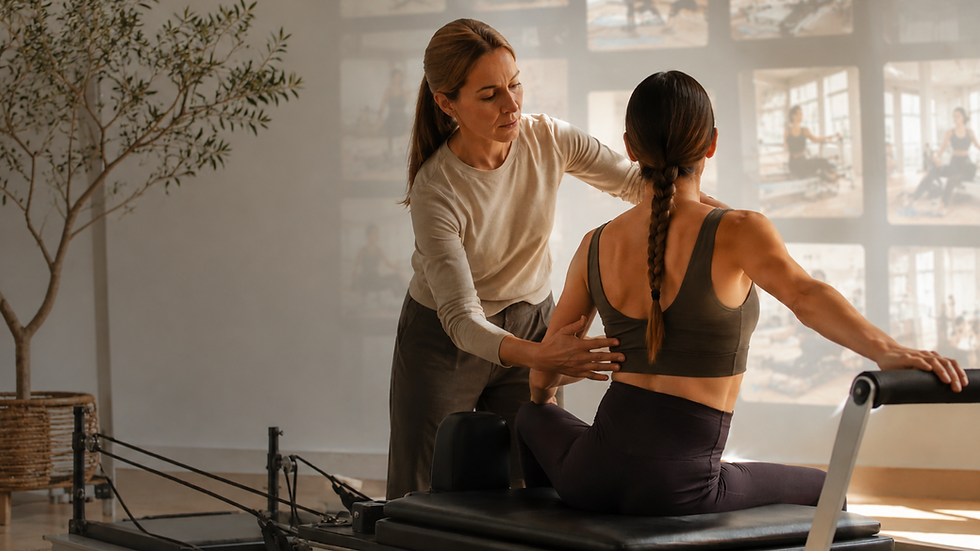
A Pilates studio should feel like a safe space. A place where the student can explore without fear of making mistakes. Where every adjustment feels like an invitation, not a sentence.
When we say:“Try organizing your pelvis this way, you may feel more stability,”we are teaching technique, yes. But we are also teaching confidence.
Especially when working with people who have experienced injuries, pain processes, or complicated histories with their bodies, language can either empower or withdraw.
More Than Moving Bodies
Teaching Pilates is not only about guiding precise movements. It is about accompanying internal processes.
Every cue can reinforce the idea that the body is clumsy… or reinforce the idea that the body is learning.
And learning requires time, exploration, and adjustments.
A single sentence can strengthen your student’s confidence.Or it can plant doubt.
Choosing how we speak is not a minor detail. It is part of professional ethics.
Because when we teach Pilates, we are not only organizing the spine or activating the core. We are also helping change the way someone sees themselves.


Comments