The spine is not flawed, it just needs to be seen differently
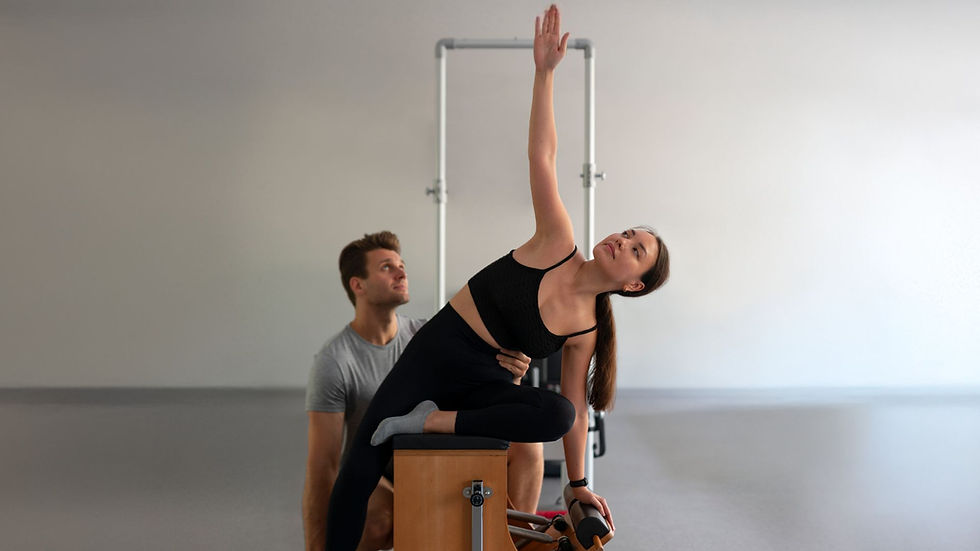
Sometimes, as Pilates instructors, when we see a very curved or very rigid back, we feel the need to “fix” it: to straighten it or bring it closer to a more aesthetic, more aligned, more “correct” version.
But the spine is not a mistake that came out wrong.
It is organized into three physiological curves: cervical lordosis, thoracic kyphosis, and lumbar lordosis. These curves are not there to make things harder, but to allow the body to absorb load, distribute forces, and move efficiently.
They are not the problem. They are part of the solution.
When you truly integrate this as an instructor, the way you teach begins to change.
Not every part of the spine needs the same thing
One of the criteria that most transforms teaching in Pilates is understanding that not all segments of the spine should do the same thing.
The cervical and lumbar areas are naturally mobile. Because of that, during movement they need stability, support, and control.
The thoracic area, on the other hand, is more rigid due to the rib cage. This is where we usually need more mobility, more expansion, and more breath.
When this principle is not clear, the body compensates. The lumbar area moves excessively because the thoracic area is not participating. The neck steps in where it should not. Over time, discomfort appears, not out of nowhere, but built movement after movement.
It is not a lack of effort. It is a lack of direction.
Teaching stops being execution
When you start looking at the spine through this lens, everything begins to organize.
As an instructor, you stop choosing exercises just because they “work extension” or “train mobility.” Instead, you begin to ask:Where do I want this movement to come from?Which area needs to stabilize and which needs to release?
Your cues become more precise.Your observations more refined.Your corrections clearer and less invasive.
The goal is no longer for the exercise to look good. It becomes about the movement being well distributed.
And even if it is not always visible from the outside, it completely changes the experience of the student.
Breath as a bridge
Many times, we try to unlock the thoracic area with more intensity, more repetitions, or more range.
But in Pilates, the most powerful tool is often the breath.
When you teach how to expand the ribs, to breathe into the back and the sides, you restore mobility where there was rigidity. And when the thoracic area begins to participate, the lumbar area stops taking on all the load.
The body does not need to be forced.It needs to be organized.
Refining your criteria is part of your evolution
Over time, you realize that being a Pilates instructor is not about accumulating repertoire. It is about going deeper into the fundamentals.
Understanding the logic of the spine.Knowing when to stabilize and when to mobilize.Making intentional decisions.
That is what brings maturity to your teaching.
If you want to continue refining your anatomical and technical criteria as an instructor, at The Pilates School, our training programs and continuing education courses dive deeply into these foundational principles that support the method.
Because when you understand how the spine is organized, you stop trying to change it. You begin to work with it.


Comments